Completion of course certificates: a practical issuer guide
What a completion of course certificate actually claims, the five fields it needs, static PDF vs verifiable credential, and how to run an issuance process you can still defend two years later.
Riya Sharma
Co-founder & CEO, CertSeal

The final module closed on Friday. The LMS export lands Monday with 184 rows, and none of the hard parts are in the spreadsheet.
One learner submitted the required assessment two days after the deadline. Another finished every lesson but missed an activity that a facilitator recorded by hand. A third enrolled through a partner system and appears twice, spelled differently each time. Someone now has to decide who qualifies, generate a certificate for each of them, check it, sign it, send it — and be able to answer a question about it eighteen months from now.
That last part is the one most issuers under-build. A completion of course certificate isn’t a polished download. It’s a claim your organization makes on the record, and its real test comes later, when a graduate, an employer, an admissions officer, or a licensing body asks: did this person actually complete this?
Treat every certificate as a record first and a visual artifact second. The design is what recipients see. The record is what survives.
This guide takes the issuer’s side of that problem. It covers what “completion” is allowed to claim, the five fields a defensible record needs, when a static PDF is genuinely enough, how to run issuance from schema to delivery, and how to handle the awkward cases — late completions, corrected names, and credentials that have to be withdrawn. If you’re looking for layout advice and copy-paste wording instead, start with how to create a certificate of completion.
The credential you issue lands in a very crowded field
The scale of the problem is worth stating plainly. Credential Engine’s 2025 Counting Credentials report identified 1,850,034 unique credentials available in the United States — including 1,022,028 badges and 486,352 certificates — offered by 134,491 distinct providers, against roughly $2.34 trillion in annual education and training spend. That’s up from 1,076,358 credentials counted in the same series in 2022.
An employer looking at your completion certificate has almost certainly never heard of your program. They cannot rank it, and they will not research it. What they can do, in about five seconds, is check whether the issuer named on the document confirms it.
The alternative is manual, and it degrades. HireRight’s 2025 Global Benchmark Report found that education-credential discrepancies were especially common in EMEA, where 47% of respondents reported finding them, and that only 7% of enterprise employers found no candidate discrepancies at all in the previous twelve months. Screening teams are already assuming that some share of what they’re shown won’t hold up. A credential that can be checked instantly is how yours stops being part of that pile.
What a completion certificate is allowed to claim
A completion of course certificate is an issuer-attested record confirming that a named person fulfilled the defined requirements of a named course by a specified date. Its job is to document completion — not to imply a level of skill the course never assessed.
That boundary is what protects the credential’s meaning. A learner can watch every lesson and submit every assignment without demonstrating mastery of anything. Say only what your records support.
| Claim level | What it asserts | Wording cue | What a verifier should be able to confirm |
|---|---|---|---|
| Completion | The learner fulfilled the stated course requirements | ”Successfully completed” | Identity, course, criteria, date, issuer record |
| Achievement | The learner met a defined performance threshold | ”Achieved”, “earned”, “awarded for” | The benchmark, the result, the award condition |
| Mastery / competency | The learner demonstrated validated proficiency | ”Demonstrated competence in” | The assessment method and the evidence of ability |
The same person can legitimately earn all three from one subject area. Finishing an introductory data science course warrants a completion certificate. Hitting the required project standard warrants an achievement certificate. Passing a practical competency assessment supports the strongest claim. The recipient doesn’t change — the evidence does.
This isn’t only an editorial concern. The Open Badges 3.0 specification from 1EdTech models the thing being awarded as an Achievement with an explicit achievementType and a criteria object. The standard makes you declare which kind of claim you’re making and what had to be done to earn it, because downstream systems need to tell a course completion apart from a license.
Before you open a template, write one sentence starting “This credential confirms that…” If the sentence describes fulfilled requirements, use completion language. If it describes quality or ability, go check whether the course records actually support it. The broader taxonomy — certificate, certification, badge, micro-credential — is laid out in what a certificate is.
The five elements of a defensible completion record
A certificate can look entirely official and still be impossible to authenticate. Trust comes from the link between the visible document and an issuer-controlled record, not from the border.

1. A unique credential ID. A serial gives staff and verifiers one precise thing to reference. Names are not identifiers — they duplicate, change, and get typed inconsistently. Print it as readable text as well as encoding it, so it survives a photocopy.
2. Recipient full name, as verified at issuance. Decide up front which system is authoritative for name spelling, and publish a correction process. A corrected record should preserve the link between the original issuance and the reissue rather than quietly replacing it.
3. Course title plus version or cohort. “Leadership Essentials” may describe six different offerings across four years. A version, term, or cohort identifier tells a later verifier which set of requirements applied.
4. Completion date and issuing organization. Use an unambiguous date format — 4 March 2026, not 03/04/26 — and name the legal or operational entity making the claim. A date without an issuer establishes nothing.
5. Signature or seal tied to a verification route. A named signer communicates authority to a human reader. A cryptographic signature plus an issuer-controlled verification URL is what makes alteration detectable. Both belong on the certificate; only one of them is evidence.
Every one of these belongs on a PDF and in a digital credential. The difference between the two formats isn’t whether the information exists — it’s whether anyone outside your organization can confirm it without emailing you.
Static PDF or verifiable credential?
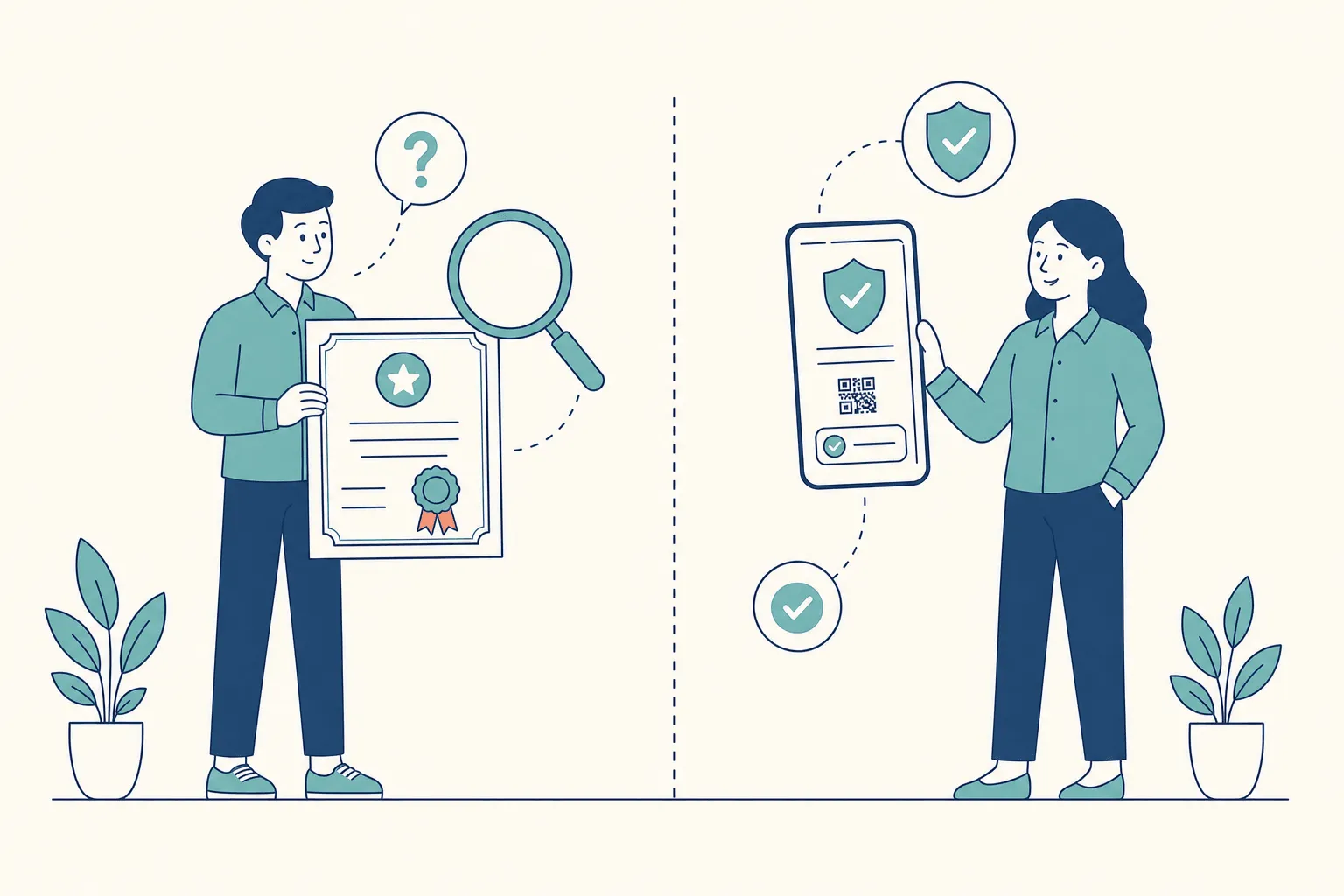
Static PDFs are not obsolete, and pretending otherwise wastes everyone’s time. Recipients understand them instantly. They can save one, print it, frame it, or attach it to an email without learning anything new. For a small internal program where nobody will ever re-check the record, a well-controlled PDF is a reasonable answer.
The limitation is narrow and specific: a PDF can be inspected, but inspection doesn’t establish that the file is original, unmodified, or still valid. A scanned image of a genuine certificate and a scanned image of a fabricated one look identical.
| Dimension | Static PDF | Verifiable digital credential |
|---|---|---|
| Verification depth | Visual inspection, then a manual email to the issuer | Public lookup with structured claims and issuer-controlled status |
| Recipient experience | Familiar file, easy to print and store | Shareable link or wallet record, usually with a printable view |
| Operational cost | Cheap to start; every correction and reissue is manual | Setup and configuration, then repeatable issuance at any volume |
| Lifecycle control | You don’t know which copies are in circulation | The verification page reflects revocation and reissue immediately |
| Best fit | Low-volume, low-stakes, rarely re-checked | Anything employers, institutions, or regulators will check |
The choice isn’t binary, and most mature programs don’t treat it as one. Send a branded PDF for display and back it with a live verification record. A dynamic QR code on the printed copy connects the two, so printing doesn’t mean abandoning verifiability — provided the code resolves to a record you maintain rather than a link that rots. If you’re evaluating platforms for this, 10 credential verification services compares how they differ on speed and portability.
Design quality still matters. It just isn’t verification. A convincing gold seal is easier to copy than a signature is to forge, and neither one tells a verifier whether you still recognize the credential. How to design a certificate covers making the verification block legible instead of decorative.
From template to verified credential: the issuance workflow
A dependable process starts before anyone opens a design tool. Begin with the record that has to exist after delivery, then let the template represent that record.
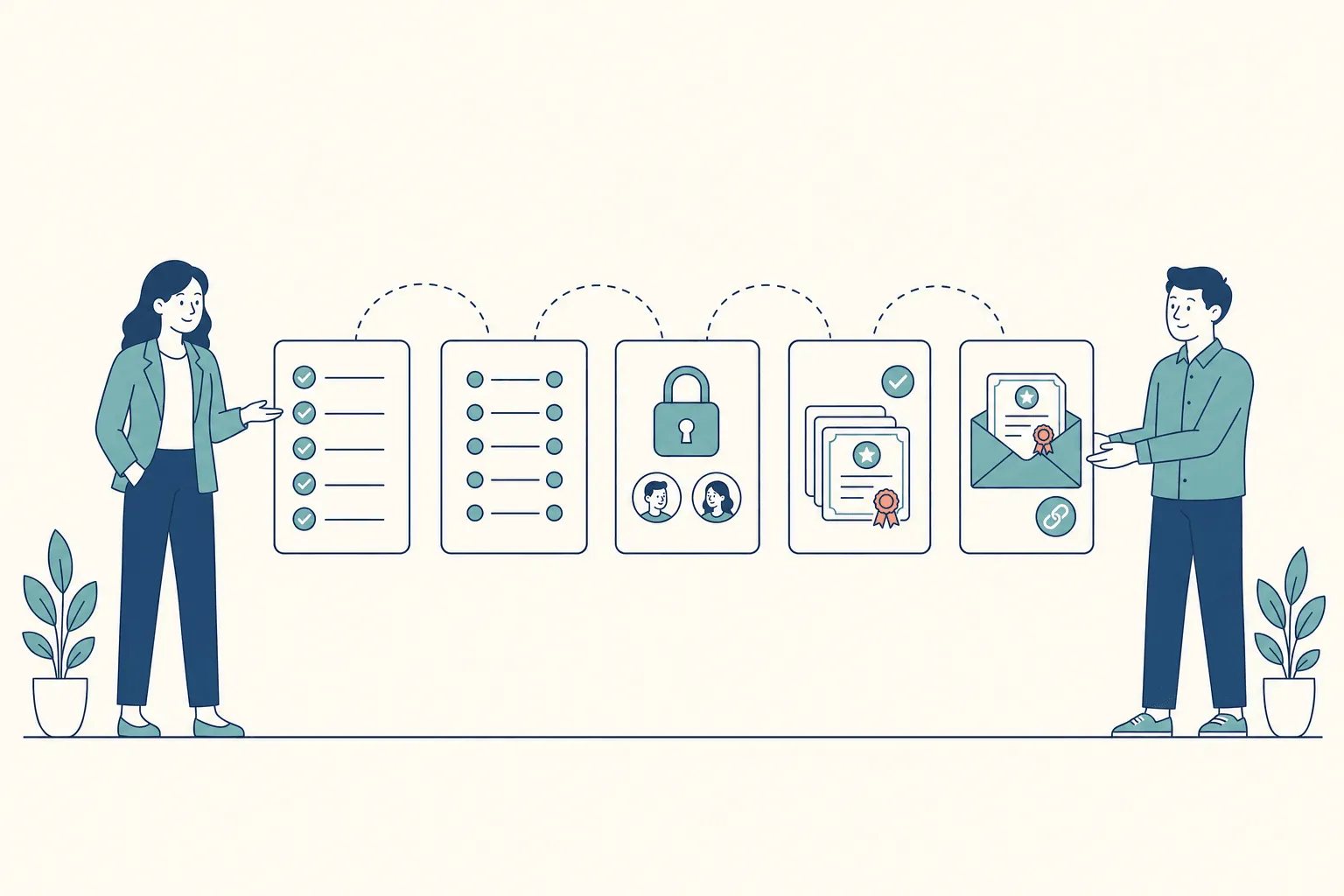
Stage 1 — Design the schema. Fix the fields your system will require: learner identity, course title, version or cohort, completion date, issuing organization, completion criteria, credential ID. Decide which are controlled values pulled from a system of record and which need human review. Anything a human types is a field you will eventually have to correct.
Stage 2 — Map fields to credential properties. Every visible claim on the certificate should have a corresponding machine-readable value: an achievement type for course completion, a stable issuer identifier, structured dates, structured recipient data. The specific standard matters less than the discipline. If the PDF says “completed all required assessments” and the digital record contains only attendance, you’ve manufactured a credibility problem that flawless design won’t cover.
Stage 3 — Control who can issue. Give program staff role-based access so only authorized people release a batch, and separate preparation from final approval. That separation is what catches the wrong course title, the ineligible learner, and the template variable that never got filled in.
Stage 4 — Pilot on a handful of records. Issue five, not 184. Check the human-readable certificate, the structured claims, the public verification page, the QR code from an actual printout, and the revocation behaviour. Then hand the links to someone who wasn’t involved in setup and watch them verify a record cold.
Stage 5 — Deliver and document. Put the verification URL on the certificate as text, explain to recipients how to share it, and keep an internal issuance log connecting each recipient to a credential ID and the eligibility decision behind it. That log is what makes an audit survivable.
A few defects recur across almost every program: hard-coded logos that outlive a rebrand, ambiguous date formats that confuse international verifiers, and spreadsheet cells carrying stale formulas that populate the wrong cohort. Validate inputs before signing, not after sending.
At volume this stops being a document exercise and becomes a pipeline. Teams running it repeatedly can push completions in from CSV or Google Sheets through the bulk generator, trigger issuance from an LMS or webinar tool via Zapier or Zoom, or wire it directly into a course platform with the REST API. The full end-to-end path is in how to issue digital certificates.
Wording that says exactly what you mean
The fastest improvement available to most programs isn’t design. It’s deleting the claim the course never assessed.
Before: “Awarded for excellence in Project Management.” After: “Successfully completed the Project Management Foundations course and fulfilled all required course activities.”
The first implies a performance distinction and invites a question you can’t answer. The second states a fact you can evidence.
Before: “Completed the Data Analytics program.” After: “Successfully completed the Data Analytics program, including the required final assessment.”
The second version tells the verifier what completion required. Don’t add an assessment clause if there was no assessment.
Before: “Completed on 03/04/26 by ABC Institute.” After: “Successfully completed the Introduction to Data Science course on 4 March 2026, issued by ABC Institute.”
Half the world reads 03/04/26 as March and half reads it as April. Pick one unambiguous format and apply it to every record you issue.
A reusable frame:
This confirms that [recipient full name] successfully completed [course title and version], comprising [total hours or weeks], by fulfilling [completion criteria] on [day month year]. Issued by [organization name], signed by [signer name and title]. Credential ID: [unique ID]. Verify at [verification URL].
Only include hours or weeks if you actually recorded them. Time spent is not a completion criterion, and stating it as one invites a challenge you’ll lose. For sector-specific phrasing, training certificate templates covers the recurring corporate formats, and the template library has completion layouts you can edit directly.
The awkward cases are the whole job
Anyone can issue a certificate to a learner who finished everything on time. The process is worth building for the other ones.
Late completions. Decide the policy before the cohort ends and publish it. If the policy permits a two-week grace period, a learner who finishes in week seven is eligible and the certificate is unremarkable. If it doesn’t, no amount of sympathetic PDF editing makes the record true. Either way, the completion date on the credential should be the date the requirements were actually met.
Corrected names. A name change or a genuine typo should trigger a controlled reissue: a new credential that references the original, with the original marked as replaced rather than silently deleted. Recipients who already shared the first link should find that it still resolves and points them onward.
Withdrawals and revocation. A credential that can be issued but never withdrawn is a record, not a credential. Programs discover this the first time a completion turns out to rest on plagiarised work. Revocation needs to be a deliberate, logged action whose result is visible to anyone who checks the verification page.
The technical vocabulary here is settled. The W3C’s Verifiable Credentials Data Model 2.0, a Recommendation since May 2025, draws an explicit line between verification — this is an authentic, current statement from this issuer — and validation, the verifier’s own judgement about whether the claim fits their purpose. It also treats status as a first-class property rather than an afterthought. The companion Bitstring Status List specification exists precisely so a verifier can learn that a credential was revoked or suspended without contacting you.
That’s the practical bar, whatever stack you’re on: a verifier should be able to see current status, not just original issue date, and they should be able to do it without creating an account. A login wall converts a five-second check into a decision not to check.
Your completion-of-course checklist
Treat this as a handoff document. It should still make sense to whoever runs the program after the person who built the first template has left.
Scope the claim
- Confirm the claim level. Completion, unless the program has evidence for something stronger.
- Define the eligible population. Who qualifies, and how late work, exemptions, withdrawals, and corrections are handled.
- Fix the completion event. The date requirements were met, in one unambiguous format.
- Name the issuer. The entity responsible for the claim, and the authorized signer.
Choose the format
- Assess the verification need. Static PDF is defensible for low-volume, low-stakes programs nobody re-checks.
- Go verifiable when third parties are involved. Employers, institutions, licensing bodies, or recipients who’ll present the credential for years.
- Consider dual delivery. A display PDF plus a live record covers both familiarity and trust.
- Audit the template fields. Recipient, course title and version, criteria, date, issuer, credential ID, signature, verification URL.
After issuance
- Test through the public path. Verify sample records as an outsider would, checking name, date, course, issuer, and status.
- Log every issuance. Eligibility decision, credential ID, issuance event, and any later correction, connected in one record.
- Publish the status policy. How a revoked, corrected, or reissued credential is identified.
- Brief recipients. How to share the verification URL and how to request a correction.
- Review after delivery. Record every defect and fix the schema, template, or approval step before the next cohort.
If you want one action today: draft your wording using the before-and-after examples above, then confirm the five record elements appear both on the template and in whatever system will answer a verification request. If those two don’t match, pause issuance until they do.
Frequently asked questions
Is a certificate of completion worth anything?
Yes — for exactly what it claims. It’s legitimate evidence that someone fulfilled a defined set of requirements, and it belongs on a professional development record. It stops being useful the moment it’s presented, or designed, as proof of assessed skill it never measured.
What’s the difference between completion and achievement?
Completion means the learner did what was required. Achievement means they met a defined standard beyond that — a grade, a ranking, a project threshold. If everyone who finishes receives the same credential, you’re issuing completion certificates regardless of the word on the border.
Do completion certificates expire?
Usually not, because the underlying fact doesn’t change: the person completed the course on that date. Compliance and safety training are the common exception, where a renewal cycle is part of the requirement. Either way, the verification record should show current status rather than only the original issue date.
What should the completion date be if someone finished late?
The date the requirements were actually met, not the cohort’s nominal end date and not the date you got round to generating the batch. If your policy allows late completion, the real date is accurate and defensible. If it doesn’t, the learner isn’t eligible.
Can I correct a name after the certificate has been sent?
Yes, through a controlled reissue rather than an edited file. Issue a new credential that references the original, mark the original as replaced, and keep both in your issuance log. Quietly swapping the PDF leaves you unable to explain a discrepancy later.
Do I need blockchain for a completion certificate to be verifiable?
No. What you need is a signed record plus a live status check, so a credential can be tested for tampering and for revocation. Blockchain anchoring is one way to publish tamper evidence; it doesn’t solve revocation on its own and it isn’t a prerequisite.
How many certificates justify moving off manual PDFs?
There’s no universal threshold, but the practical trigger is repetition rather than volume. If you issue more than a handful per quarter, or the same corrections keep coming back, the manual process is already costing more staff time than configuring a repeatable one would.
The short version
A completion of course certificate is a claim: this named person fulfilled these defined requirements, on this date, under our authority. Everything that makes it useful follows from taking that claim seriously — stating only what you assessed, recording the five elements that let someone else check it, choosing a format that matches who will do the checking, and building an issuance process that handles the late finisher and the corrected name without improvisation.
The design decides whether a recipient is proud to share it. The record decides whether it means anything when they do.
CertSeal helps training providers, institutions, and employers design completion certificates, issue them in bulk with shareable verification URLs and QR codes, and manage status changes like revocation and reissue. Try the free certificate generator with no account, build a layout in the certificate maker, or see pricing for full programs.
Start free with CertSeal — 100 verifiable certificates a year, no credit card.
Related reading
- How to create a certificate of completion — templates, six wording examples, and design tips
- What is a certificate? — types, uses, and how verification actually works
- How to issue digital certificates in 2026 — bulk delivery, verification, and analytics end to end
- 10 credential verification services, compared — how the platforms differ on speed and portability
- How to launch a certification program in 2026 — the governance behind a stronger claim
Keep reading
Certificates
What is a certificate? Types, uses, and how verification works
A certificate is issuer-signed proof of a defined achievement. Here's what it actually claims, how completion, achievement, and competency differ, and why verification decides whether it counts.
Verification
Dynamic QR codes for verifiable credentials
How dynamic QR codes keep printed credentials verifiable: the two-layer architecture, the trust dependencies it creates, design constraints that survive a printer, and the governance rules large programs need.